MHS
TEMPORARY
TRAFFIC CALMING
DOUGLAS ROAD AND OAK MEADOWS DRIVE
CABOT, ARKANSAS
1997
The underlying philosophy of traffic calming is to change driver behavior through passive discouragement. Passive discouragement, in the form of alterations to the physical environment, has several inherent advantages over active discouragement, in the form of law enforcement. First, passive devices are less expensive, as the only costs are the initial capital investment and the period maintenance costs. Second, passive devices work 24 hours a day, 7 days a week.
However, despite these advantages, there are several disadvantages as well. Passive devices are not easily installed or removed. Second, because of their permanence, passive devices do not allow for testing for effectiveness -- once they are installed, they remain, regardless of their effectiveness, necessity, or desirability.
As the Public Works Director of Cabot, Arkansas, Michael Schrader combined the flexibility of active devices with the "around-the-clock" effectiveness of passive devices by using temporary traffic calming methods. Under this approach, the traffic calming methods can be tested in the field for effectiveness, necessity, and desirability, and can be quickly relocated from one location to another.
PORTABLE SPEED BUMPS
DOUGLAS ROAD
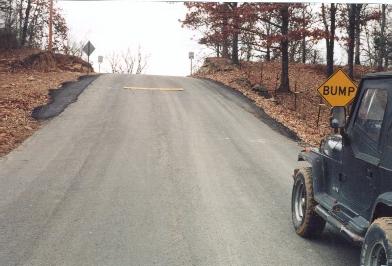 (Portable speed bumps on Douglas Road, Cabot, Arkansas. Photo by the Cabot Star-Herald.)
Because of a problem with "hill jumping" on Douglas Road, Michael
Schrader
installed portable speed bumps on both approaches to the problem hill, which
was locally known as "Jump Hill". The
purpose of the portable speed bump installation was twofold --(1) to reduce
speeds at the crest of the hill, and (2) to discourage the use of Douglas Road
by non-local traffic. The 8' long
portable speed bumps were placed in the center of the road, allowing adequate
space for vehicles to go around the bumps at a low rate of speed. Thus, whether a vehicle chose to go over the
bumps or around them, the speed reduction was the same. After several months, traffic volumes had
dropped and "hill jumping" ceased, and the speed bumps were removed and
relocated to a different location.
PORTABLE
CHICANE
OAK MEADOWS DRIVE
 Because of chronic speeding problems, the
residents of Oak Meadows Drive requested that traffic calming be installed on
their local residential street. As a
result of this request, Michael Schrader installed this mid-block portable chicane
made up of construction drums. Although
the chicane was effective at reducing speeds, several of the residents
concluded that while traffic calming was effective, it wasn't desired at this
particular location. The portable
chicane was promptly removed.
Because of chronic speeding problems, the
residents of Oak Meadows Drive requested that traffic calming be installed on
their local residential street. As a
result of this request, Michael Schrader installed this mid-block portable chicane
made up of construction drums. Although
the chicane was effective at reducing speeds, several of the residents
concluded that while traffic calming was effective, it wasn't desired at this
particular location. The portable
chicane was promptly removed.
(A vehicle passes through a portable
chicane on Oak Meadows Drive in Cabot, Arkansas. Photo by the Cabot Star-Herald.)